
Posted March 21, 2026, by Dr. George Farmer

Throughout a single day, administrators face a multitude of decisions, ranging from minor tasks such as assigning teacher coverage to major decisions that affect the safety of students and staff. These choices compound with constant concerns that demand immediate attention. Leaders are expected to make quick judgments with significant consequences, and the pressure from staff to respond swiftly is frequent and unrelenting.
Now more than ever, the pressure to make the right decision quickly is paramount. Yet decision fatigue can cloud and weaken a leader’s ability to act thoughtfully and accurately. Decision fatigue is not a myth. I have experienced moments of mental, emotional, and physical exhaustion caused by making too many decisions, which inevitably diminishes decision quality. At times, I’ve forgotten decisions I made or had to revisit them because those decisions were not well considered. What I’ve learned is the power of empowering and trusting my administrative team to make “smaller” decisions so that I can preserve the capacity needed for the “bigger” ones, reducing the effects of decision fatigue.
Over the years, I have developed a deeper understanding of the process and necessity of becoming an elite decision-maker as a school and district leader. Elite decision-making is not a foreign concept; when paralleled with sports, all great leaders possess this quality. Michael Jordan, LeBron James, Peyton Manning, and Tom Brady shared the ability to make the best decision at the most crucial moments.
While all decisions have importance, not every decision is a priority in that specific moment. Prioritizing is essential. Staff members often believe their concerns are the most urgent, but only school leaders have the full view of the school and district needed to determine what truly requires immediate action.
School leaders must develop the capacity to make impactful, timely decisions that sustain organizational success. Much like great athletes, administrators must possess key characteristics to become elite decision-makers.
Deceleration
From teacher concerns and student behaviors to parental needs, finances, maintenance, and operations, the decisions are nonstop. It can feel as though every direction you turn, a new decision awaits. Yet it is possible to slow the process down while still making timely, accurate decisions.
I recall a moment when my social worker approached me with urgency, asking, “What are you going to do?” The situation required possible involvement from local authorities and Emergency Medical Services; needless to say, this decision had serious implications. Although the pressure was intense, I told my social worker I was unsure of the immediate decision I was going to make. In truth, I had a strong sense of the right decision, but I needed space to confirm it. I took a brief walk to my office, sat down, and clarity followed. Though the moment felt long, the actual decision took less than ten minutes. By resisting pressure to decide immediately, I made the best choice for the school.
In retrospect, I intentionally distanced myself from external pressures to reflect on the school as an interconnected system and the implications of each option. Leaders must create the conditions necessary for sound decision-making, even if that requires stepping away to a quiet space.
One Decision Affects Many Systems
As I reflected in my office, I considered which systems would be affected by this single decision. Effective administrators must evaluate the ripple effects: Which students are in the building? How will families be impacted? Are siblings involved? Who must be notified, from the county office to the central office to the police to EMS.
The final layer involved weighing the ramifications of each option. What happens if I do make Decision A? What happens if I don’t? The same for Decision B. When I evaluated all systems and outcomes, the right decision became clear. One misguided decision can send shockwaves through a school system, while one sound decision can ensure operations continue smoothly.
There is no decision that does not affect other systems within a school. Effective leaders maintain a 360-degree lens, anticipating the impact of each choice. They ensure that all areas are thoughtfully evaluated before determining the best course of action. One misguided decision can send shockwaves through a school, disrupting systems, while one sound decision can strengthen safety, instruction, and operations.
Only the Facts Matter
Many factors can interfere with an administrator’s ability to make sound decisions. The most harmful are bias and misinformation. In any situation, everyone has a story or version of events, which can delay the gathering of accurate information. By committing to collect facts only from those directly involved, leaders avoid false narratives and save valuable time.
Bias also undermines decision-making. When bias is present, equity and clarity disappear. Leaders must not allow personal likes, dislikes, or assumptions to influence their judgment. My decision-making approach has evolved to center on three elements: the facts, the handbook, and the policy.
When used together, these three elements create a system of checks and balances. The facts ground the decision in truth, the handbook aligns it with school-based expectations, and the policy ensures compliance and consistency at a systems level. Relying on all three minimizes bias, reduces ambiguity, and leads to decisions that are defensible, transparent, and centered on equity.
To lead effectively in today’s complex educational landscape, school and district leaders must embrace decision-making as both a skill and a discipline. Deceleration, system thinking, and commitment to factual, unbiased information are essential tools that distinguish good leaders from elite ones.
As the demands of our work continue to grow, leaders must prioritize clarity over speed, strategy over reaction, and collective leadership over individual burden. By refining our decision-making processes and empowering our teams, we safeguard the well-being of our schools and ensure that every decision, big or small, advances the success of the students and communities we serve.
Posted June 20, 2021 by Dr. George Farmer

90% of the world is right-handed; therefore, it makes sense that the world is tailored for right-handers. It is also conceivable why school supplies are readily accessible for right-handed students. The general assumption when teaching is students are right-handed, but what happens when a left-handed student arrives?
It is not surprising that when left-handed students arrive, educators are forced out of their comfort zones and scramble to find left-handed scissors, teach left-handed pencil grips, and are generally forced to make the appropriate adjustments to ensure the left-handed student is placed in the best position to succeed.
Growing up with three siblings, I observed two of my left-handed siblings forced to conform to a world of right-handed people. In hindsight, society’s responsibility was to be cognizant and make accommodations of left-handed people’s inclusivity in a right-handed world, not my siblings.
Coincidently, education has tailored learning into one method that isolates different learners, but what about the small percentage of students who think differently?
When Covid-19 arrived, the world was left with no choice but to surrender. Education was halted for weeks until the realization was the pandemic was not going away quickly. Education had to adjust, much like the educator that makes the proper adjustments for the left-handed student.
It is no secret, educators have known that school is not a one size fits all approach hence the trends of movement, discussions, and collaboration. While these methods were improvements, there remained a set of students who struggled in the classroom. Undoubtedly the pandemic brought many tragedies, and Covid-19 may have ushered in an era where different learners thrive with in-person learning.
Consider Student A, the introvert. This student always shows up to class, completes assignments but hides in the sea of students hoping never to be called upon, and rarely speaks when collaborating on assignments. While Student A knows the content, Student A’s grades do not reflect Student A’s true potential because Student A is not an extrovert.
However, because of remote learning, Student A completes all asynchronous assignments without any help, and while Student A remains on mute the entire lesson, Student A participates in lessons through the chat feature. Remote learning has been a positive experience that enables Student A to thrive.
On the other hand, Student B was less enthusiastic about school before Covid-19. Student B was a frequent visitor to the water fountain and was a consistent centerpiece for student conflict. Student B was below grade level, avoided assignments at all cost, and refused help to avoid being perceived as “stupid” by peers. Student B was absent from class in the early stages of remote learning or refused to display the camera. The teacher was able to help Student B in breakout rooms in one-on-one virtual settings. This approach was best for Student B as the pressure from peers was nonexistent. Since Covid-19, student B has made significant progress.
Post Covid-19, most thinkers will resume education as usual, but what about the different thinkers?
Make no mistake about it, all learners are essential, but education cannot abandon the different learners. Society assumes everyone is right-handed, and in the same vein, education assumes every student processes the same, and when students do not master content based upon thinking assumptions, students are often forgotten or discarded.
Reflect for a moment; at some point; we have all been different thinkers. For me, it was throughout my elementary, middle, and high school years as I struggled with math. I needed my math teachers to realize I did not approach math like 90% of my classmates and needed someone to show me a different approach that was conducive to my thinking style.
I did not conceptualize numbers as most of my peers; therefore, I did not approach math like my peers. I was not inferior; I just thought differently than my peers.
When school resumes, thoughtful consideration to accommodate all learners is essential.
Educators have created innovative ideas to reach all students during these challenging times. When school returns to “normal,” education cannot afford to discard practices and accommodations that enabled the success of all students.
How to Accommodate All Students Post Covid-19
1. When teaching in-person, incorporate technology or methods that enable the quieter students to engage other than orally.
2. Provide space even if online for the “avoider” to receive support without fear of labeling,
3. Aside from IEP modifications, provide special education students with more opportunities and options that enable success.
4. Provide multiple strategies that enable all learning pathways. Give students options of different methods to approach learning.
Remote learning has had a positive experience for some students. By combining previous successful methods with the newly discovered remote learning methods, education can be a successful experience for all students. It would be a disservice to throw away successful remote learning aspects that have been effective for the “few.”
Different learning styles strengthen the learning experience for all students. We cannot throw away the successful teaching practices learned during the pandemic. Education must embrace and accommodate different thinkers because our future is dependent on the success of all students.
Autism: Our Journey from Awareness to Acceptance By: Dr. George Farmer
 It’s incredible how time flies. My wife and I sat in the neurologist’s office in 2019 as our son was assessed for autism. The signs were evident; I was finally past the point of denial and ready to accept the diagnosis of autism. For me, I was aware of autism, but the journey to acceptance was not easy.
At birth, I was confident in my son’s milestones as at three days old; he would lay on his belly and hold his head up without assistance. At just seven months, he began to walk, which quickly turned into running. With the biggest smile, he would look into our eyes, laugh, smile, and want to play all day and night.
While our son was growing and developing, we were unaware of the shift that would slowly begin.
At his first birthday party, we planned a big birthday celebration at a hands-on activity center with live exhibits for children. The private party room was filled with family and friends that wanted to show their love for our son. It was surprising that our son would cry when we entered the party room with our guests. The crying was so loud and persistent that I had to take him out of the room, which was the only way he would stop crying, but me being a new parent, I just assumed he was tired and was not in the mood for partying.
Months following, we noticed our son would cry for extended periods at night nonstop. Again, I assumed we just had to wait it out, but my wife had the intuition to know this was not typical behavior for a baby. As time progressed, my wife noticed his language was not developing into complete sentences, but again I believed that maybe his progress was a little delayed.
Our next journey was introducing our son to daycare at age three. Daycare was a difficult stage as our son would only take to one teacher, he would not nap, he would not use the potty until he got home, and typically would not interact with the other students. One teacher tried to discuss how there were signs of autism. We decided to change daycares for various reasons thinking a new daycare would provide the care and attention we knew he needed.
Daycare two had more success than the first; however, there was one glaring moment. Pre-kindergarten graduation was an eye-opening moment for me when my son was glued to his teacher and when side by side with his peers, there was a significant difference in his actions and expressive and receptive language. Before this moment, my wife was ready to have him evaluated, but it was that very moment when I moved from awareness to acceptance.
The facts are that in 2010, 1 in 125 children were diagnosed with autism, and just ten years later, 1 in 59 were diagnosed. The numbers take a whole new meaning when one of your children is diagnosed.
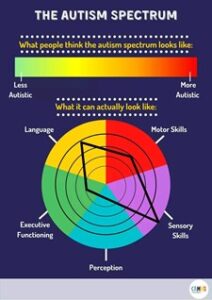
We learned quickly that the diagnosis of autism was not just a diagnosis for our son, but rather a diagnosis for the family as autism affects all family members. While autism is a spectrum disorder that encompasses a wide range, no two cases of autism are the same. The spectrum is often thought to be linear, but it is more circular, with strengths varying depending on the person. The saying is true, “if you meet one person with autism, you’ve only met one person with autism.”
Through the years, television has created stereotypical views of autism. It has become difficult to break down the walls that believe all people with autism behave, speak, and think alike. I recall a conversation when someone insinuated that my son needed to be “changed.” The only necessary change is how the outside world views people diagnosed with autism.
We love every distinction that makes our son unique. We celebrate the incredible strides he has made with school, including his development in expressing his feelings, emotions, and thoughts. We even enjoy the playful banter he has with his brother and sister that often leads to arguments. We couldn’t imagine our lives any different and are equally proud of all our children.
The fact is every person with autism deserves the same care, love, attention, and rights as any other person.
Gone are the days of apprehension of going out to eat, enrolling our son in recreational sports, flying on planes, or enjoying any other functions and activities that children enjoy.
While I applaud Autism Month, the reality is autism is 365 days a year. Therefore, the battle for inclusivity is ongoing; beyond April, our community will continue to fight for awareness, acceptance, and inclusiveness in the schools, community, and workplace, but we need your support.
How to Support the Autism Community
Acceptance – Embrace individuals of all ages to welcome people with autism. Children with autism are more likely to be excluded and treated harshly by their peers.
Understanding- There are no two cases of autism that are the same; therefore, each individual’s needs are specific. Discover the unique preferences and needs of individuals diagnosed with autism.
Time – Time is valuable and can mean more than one can imagine. Take time to research to become educated about autism. There are numerous amounts of misinformation, and it is essential to be informed accurately.
Inclusivity – Be the voice to declare equal opportunity and access. Every opportunity should include options of inclusion for individuals with autism. Where inclusivity is absent, raise awareness for the need.
Support – Some families need support through conversation or other means, but one will never know unless the time is taken to engage in conversation. In other instances, research is ongoing for the causes of autism in various walks, runs, and events, when possible contribute through finances or partaking in the events.
Mindfulness- Be cognizant of the stares and glares. Remember that sensory can be intensified when in public, leading to challenging moments for individuals with autism and their families. There is no need to be afraid or be in fear but be mindful that comments and stares can have damaging effects.
What my wife and I learned most through our journey is our son can and will be a successful contributor to the world diagnosed with autism. We are grateful to be his parents and will advocate for him and all diagnosed with autism. As we proudly and boldly raise awareness and acceptance during April, our voices and actions for autism advocacy are year-round.